


























Specialist, associate specialist and specialty (SAS) doctors are an essential part of today’s medical workforce, yet their roles, career pathways and senior potential are still inconsistently understood. By bringing together the perspectives of four specialist doctors, and exploring the value that they bring to services, we hope to shed light on what these specialist roles look like in practice – and how doctors and employers can enable progression into these posts.
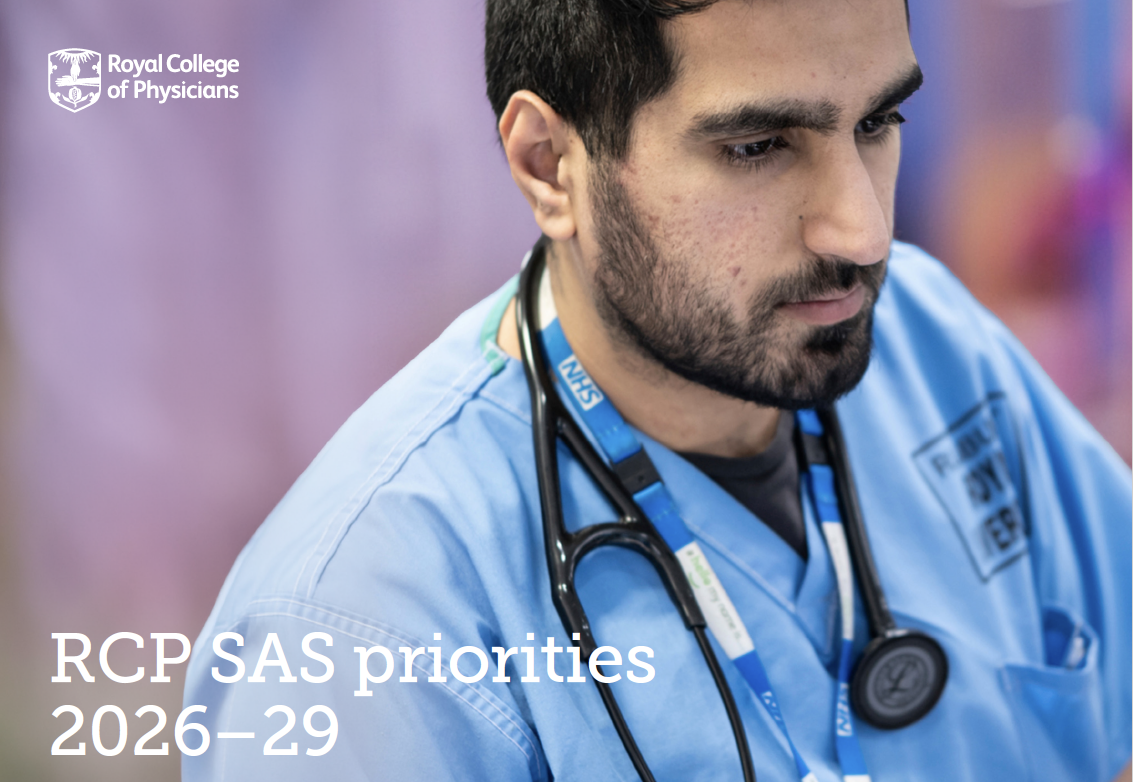
Their reflections align closely with the new RCP SAS priorities 2026–30, which were launched in April. This emphasises recognition, development and leadership for SAS doctors. Initiatives such as the newly established SAS forums further underline a renewed commitment to visibility, engagement and a collective voice within the RCP and across the profession.
Dr Naeem Aziz FRCP
SAS lead and council member, associate specialist, SAS advocate and clinical director at Aneurin Bevan University Health Board, and clinical director and strategic workforce planning lead for Powys Teaching Health Board
For many doctors, the specialist SAS role remains misunderstood. As an associate specialist who is now also a clinical director, Naeem explains, ‘The rules are there. They have always been there. What we lack is not regulation, but understanding and the confidence to use what already exists.’
Having trained overseas and worked at consultant-equivalent level before joining the NHS, Naeem chose a permanent SAS route rather than entering UK training. Over 2 decades in the same organisation, his role has evolved in line with experience and service need. ‘There is no upper end to scope of practice,’ he says, ‘It depends on what a doctor can safely do and what the service needs.’
Now with responsibility spanning multiple hospitals, he brings a dual perspective as both a senior leader and an SAS doctor. He challenges the way that scope of practice is often discussed, warning that it can unintentionally reinforce bias. ‘It is talked about as if it is specific to SAS doctors,’ he notes, ‘but I define scope of practice for consultants as well. It applies to everyone according to their skill set. Scope of practice is defined, not restricted.’
From an employer’s perspective, Naeem believes that workforce planning should begin with a simple question: what does the service need?
Where the requirement is senior, autonomous clinical care focused on service delivery, he believes that specialist roles are often the most effective solution. ‘Specialist job plans focus on direct clinical care,’ he explains, ‘They help retain experienced doctors, reduce reliance on locally employed doctors (LEDs), especially locum consultants and improve continuity. At the end of the day, it is about quality of care.’
For specialty doctors aspiring to progress, his advice is direct:

Clinical knowledge alone is not enough. You must be proactive, because you are outside a formal training structure.
Dr Naeem Aziz
RCP SAS lead and Council member
Leadership skills matter too. ‘Communication, confidence, adaptability and leadership are what make the difference when employers consider you for senior roles.’
Reflecting on his journey, he describes himself as a ‘living example’ of what is possible within the SAS framework, observing that the pathway already exists. What is needed now is consistent understanding and the confidence to use it well.

Dr Helen Bonwick OBE FRCP
Associate specialist in palliative medicine at Marie Curie Hospice Liverpool and Liverpool Heart and Chest Hospital, and past RCP SAS representative for the Mersey region.
Helen is an associate specialist in palliative medicine, with senior clinical and leadership responsibilities. Reflecting on more than 2 decades in the specialty, she describes building a career through sustained experience at a time when palliative medicine was not yet formally recognised. When structured training routes emerged, she deliberately chose not to pursue them, finding that the SAS role offered ‘a better way of maintaining my work–life balance’ while allowing her to focus on teaching and service development.
That choice, she notes, is still often misunderstood. She is clear that senior SAS and specialist doctors are not working at a lower level than consultants. ‘In a specialist role, I can really do everything a consultant does,’ she says – but she often needs to remind people of that. Remaining in a single organisation over time allowed her to build credibility, institutional knowledge and trusted relationships. ‘That is the experience you can’t replicate,’ she reflects.
She argues that specialist SAS roles should be seen not as exceptional, but as a strategic approach to retaining highly experienced clinicians. Progression, she suggests, often formalises work already being done, ‘you are effectively already working at that level.’ Clear routes into specialist roles can be highly motivating, strengthening long-term commitment to a service.
Despite this, understanding and support for specialist roles vary considerably. Access to leadership and educational opportunities, she explains, is often shaped by local interpretation rather than national frameworks: ‘the barrier is always at the coalface,’ she observes.
Leadership development, when it does happen, is frequently enabled by individual sponsorship. Being actively invited onto senior leadership programmes alongside consultants was a turning point, signalling that she was ‘just as legitimate’ in those spaces. It is why she has committed to supporting the current SAS leadership programme at the RCP.
Her advice to SAS doctors is pragmatic. Evidence should be gathered early, progression treated as a genuine career pathway, and support actively sought. She advises:

You should look for mentors and sponsors, people who will say your name in a room full of opportunities.
Dr Helen Bonwick
Former RCP SAS representative for the Mersey region
For her, the case for specialist SAS roles is ultimately one of fairness, sustainability and service continuity.
Dr Emily Millen
Specialist haematologist and co-director of Nottingham Haemophilia CCC (Comprehensive Care Centre), Nottingham University Hospitals NHS Trust.
For Emily, the decision to leave formal training was not taken lightly. Having trained in haematology and passed her first round of specialty exams, she reached a crossroads after a prolonged period of ill health that forced her to reassess what she could realistically sustain. ‘At the time, it felt like one of the hardest decisions I had ever made,’ she recalls, ‘it felt like failure, because you get on this career train and you are not supposed to get off until you reach consultant.’
With hindsight, her perspective has shifted completely. Now more than 5 years into a substantive specialist role, she describes it as ‘the best decision I’ve ever made.’ The flexibility of the specialist pathway has allowed her to shape a post around areas she enjoys most, creating her ‘perfect combination of subspecialties’; something that she feels would not have been possible through the traditional consultant route.
In her department, parity with consultant colleagues is the norm. Her clinics, patients and leadership responsibilities mirror those of consultants; she has full autonomy, equal access to CPD, job planning and leadership opportunities. However, she recognises that this experience is not universal. ‘There is still that assumption that you go into a SAS role because you’ve failed in some way,’ she says, noting that these perceptions can affect confidence even where structural barriers are absent.
One of the most valuable pieces of advice she shares came from an associate specialist early in her career: know your worth and choose your environment carefully.

As a specialist doctor, you need to know that the place you work really respects your true value.
Dr Emily Millen
Specialist haematologist
Without that respect, even well-designed roles can become frustrating.
Her practical advice is simple. Make your interests known, build visibility within your specialty, and engage in projects, networks and publications. Above all, she emphasises that the specialist route should be recognised as what it is: not a fallback, but a positive and sustainable career choice that supports both professional fulfilment and life beyond work.
Dr Vineet Pant FRCP
Specialist in nuclear medicine at NHS University Hospitals of Liverpool Group, RCP SAS regional representative for Mersey.
For Vineet, a specialist in nuclear medicine with 18 years of experience as a doctor, the route into a specialist post was not widely understood. When he joined the NHS only 4 years ago, he progressed to a specialist role within 2 years. ‘It is a difficult path,’ he reflects, ‘but it is not an impossible one.’
Now working at a major teaching hospital, he describes moving into the specialist role as a natural progression of capability rather than a change in practice. ‘I was already doing the work independently,’ he explains, ‘so, the question was, why not move into a role that recognises that level of responsibility?’
His progression was not through a clearly defined or advertised pathway. Instead, it came through curiosity and collaboration. Alongside a supportive clinical lead, he explored available options and identified the specialist grade as the most appropriate route. ‘People are still not very aware of the specialist role, even within organisations, there is a lack of understanding.’
This lack of awareness was the most significant barrier. Despite clear national criteria, navigating the process required persistence, repeated conversations and external guidance. ‘For 3 or 4 months, nobody knew how to move it forward,’ he explains, ‘you are often told to speak to someone else.’ Getting local support from your own department helps, ‘for me, my clinical lead provided valuable support, then the RCP and BMA clarified the pathway.’
For Vineet, the specialist role offers autonomy, recognition and the opportunity to contribute more fully to service delivery. However, he emphasises that progression into leadership roles requires active engagement.

Nobody will give you these roles, you must step forward and take responsibility ... After getting specialist grade, I was positively motivated and was able to obtain prestigious RCP fellowship, furthering my opportunities.
Dr Vineet Pant
Specialist in nuclear medicine
He offers practical advice to others; first, develop leadership behaviours early and actively seek opportunities rather than waiting to be asked. ‘If something needs doing, offer to do it,’ he suggests. Second, prepare evidence for the specialist role carefully and present it in a clear, structured way. ‘The person reviewing your application should be able to see everything in one glance,’ he advises. Third, use feedback constructively and build relationships with those who can support your progression.
Reflecting on his journey, he highlights the importance of external perspective. The RCP SAS leadership programme has been invaluable in building his confidence; ‘engaging with organisations such as the RCP can provide impartial guidance and reassurance’. Ultimately, his message is one of confidence and proactivity. For those willing to seek out opportunities and demonstrate their capability, the specialist pathway is both achievable and rewarding, he says. ‘As an RCP SAS doctor representative for the Mersey region, I now want to help others in achieving their goals towards specialist grade.’
Bringing value to healthcare
Specialist SAS roles are essential to a sustainable, high-quality medical workforce and that progression depends on both individual development and informed organisational leadership, and the perspectives of these physicians shows that clearly. The RCP’s SAS priorities 2026–30 set out a clear commitment to recognition, progression and leadership for SAS doctors, supported by practical initiatives such as the RCP SAS leadership programme, which equips SAS doctors to step confidently into senior clinical and strategic roles.
Your collective experience
Hear more personal stories like these and celebrate the SAS role at our upcoming SAS forums. These informal online meetings are designed to offer a platform for discussion and a space to share best practice and offer guidance to your SAS peers. All are welcome.
Find out more ways to get involved with the RCP SAS Network and take a look at our career resources:
Dr Lucy Harding
RCP senior educationalist